Table of contents
- Moshi and Pune Dental Implant Statistics 2025–2026
- What Is a Dental Implant and How Does It Work?
- What Does a Dental Implant Cost in Moshi in 2026?
- Factors That Affect the Implant Cost in Moshi
- Step-by-Step Implant Process at Smile Care Moshi
- Who Is a Good Candidate for a Dental Implant?
- Post-Treatment Oral Hygiene for Dental Implants
- Dental Implants in Moshi: Local Context for Pune Patients
- Frequently Asked Questions
- Conclusion
Key Takeaways
- A single dental implant in Moshi costs between INR 25,000 and INR 60,000 depending on the implant brand and crown material.
- Dental implants have a global clinical success rate of over 95% at ten years when placed by a qualified implantologist (PubMed).
- The implant process typically involves 3 to 4 clinic visits spread over 3 to 6 months, including healing time.
- Bone grafting may add INR 8,000 to INR 20,000 to the total cost if jaw bone density is insufficient.
- Controlled diabetics and non-smokers are good implant candidates; uncontrolled systemic conditions reduce success rates.
Dental implant cost in Moshi in 2026 typically ranges from INR 25,000 to INR 60,000 for a single tooth, depending on the implant system used and the type of crown placed. If you have been living with a missing tooth and wondering whether implants are financially within reach in Moshi or the wider Pimpri-Chinchwad area, this guide gives you honest, transparent figures without the marketing language.
This post has been written with clinical oversight from Dr. Pawan B. Sawalakhe, MDS Periodontist and Implantologist, and Dr. Vishakha Sawalakhe, MDS Prosthodontist and Implantologist, both of Smile Care Dental Clinic and Implant Centre, Moshi, Pune. All cost figures are based on 2026 Pune market data and verified clinical sources.
Quick Facts
Single Implant Cost in Moshi: INR 25,000 to INR 60,000
Full Arch Implant (All-on-4) Cost in Pune: INR 2,50,000 to INR 4,50,000 per arch
Bone Graft Add-on: INR 8,000 to INR 20,000 (if required)
Clinical Success Rate: Over 95% at 10 years (PubMed meta-analyses)
Treatment Duration: 3 to 6 months from placement to final crown Clinic: Smile Care Dental Clinic & Implant Centre, Moshi, Pune
Moshi and Pune Dental Implant Statistics 2025–2026
| Metric | Data Point | Source |
| Average single implant cost in Pune | INR 25,000 to INR 60,000 | Industry estimate |
| Global implant success rate at 10 years | 95.1% | PubMed / Cochrane Review |
| Estimated implants placed in India annually | Over 5 lakh procedures | Industry estimate |
| Implant failure rate in smokers vs non-smokers | Up to 2.5x higher in smokers | PubMed |
| Bone graft success rate for implant support | 90 to 95% | Journal of Oral Implantology |
| Patients with diabetes requiring HbA1c < 8 pre-surgery | Mandatory protocol | AIIMS / IDA Guidelines |
| Cost difference: Pune vs Mumbai for same implant | 20 to 35% lower in Pune | Industry estimate |
| Implant crown lifespan with proper care | 15 to 25 years | PubMed |
What Is a Dental Implant and How Does It Work?
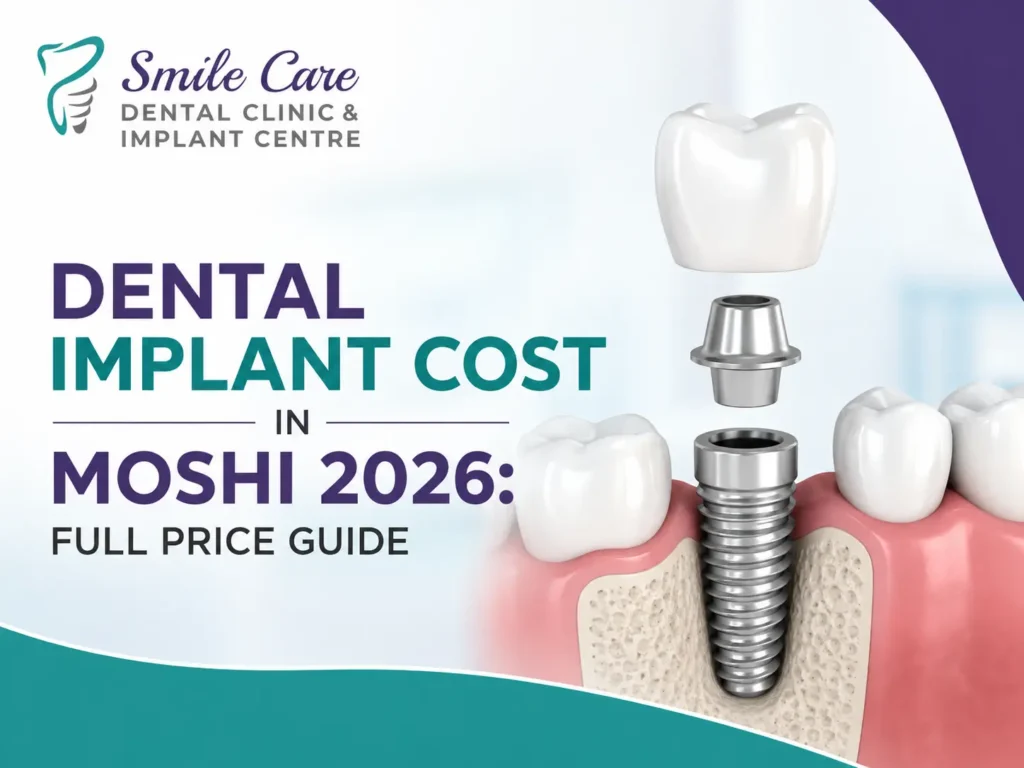
A dental implant is a titanium or zirconia post that is surgically inserted into the jawbone to act as an artificial tooth root. Once the implant fuses with the bone through a process called osseointegration, an abutment is attached, and a permanent crown is placed on top. The result looks and functions like a natural tooth.
Unlike a dental bridge, an implant does not depend on neighbouring teeth for support. Unlike a removable denture, it stays fixed in the mouth and allows normal chewing, speaking, and brushing. According to PubMed meta-analyses published between 2020 and 2024, dental implants have a survival rate exceeding 95% at ten years, making them the most durable tooth replacement option available.
The implant is most commonly made of commercially pure titanium or titanium alloy, both of which are biocompatible and accepted safely by human bone tissue. Zirconia implants are an alternative for patients with metal sensitivities, though they are less commonly used and come at a higher cost.
What Does a Dental Implant Cost in Moshi in 2026?
The total cost of a dental implant in Moshi depends on four main variables: the brand of the implant post, the material of the crown, whether bone grafting is required, and the specialist qualifications of the treating dentist. Here is a realistic breakdown.
| Implant Type | Components Included | Estimated Cost in Moshi/Wakad |
| Single Tooth Implant (Indian brand) | Titanium post + abutment + PFM crown | INR 25,000 to INR 35,000 |
| Single Tooth Implant (Korean/European brand) | Premium post + abutment + zirconia crown | INR 40,000 to INR 60,000 |
| All-on-4 Full Arch | 4 implants + fixed prosthesis (acrylic) | INR 2,50,000 to INR 3,50,000 |
| All-on-6 Full Arch | 6 implants + fixed prosthesis (zirconia) | INR 3,50,000 to INR 4,50,000 |
| Implant + Bone Graft | Implant + xenograft or autograft material | Add INR 8,000 to INR 20,000 |
| Implant + Sinus Lift | Implant + sinus augmentation surgery | Add INR 15,000 to INR 30,000 |
These are market-rate estimates for Moshi and the wider PCMC region as of early 2026. Costs at tertiary hospitals in Pune city or branded dental chains can be significantly higher for equivalent treatments.
What Is Included in the Quoted Price?
Factors That Affect the Implant Cost in Moshi
- Implant brand and origin: Indian brands such as Osstem, Adin (Israeli), and Straumann (Swiss) vary in cost. Indian-manufactured implants cost less but carry equivalent certification.
- Crown material: Porcelain-fused-to-metal (PFM) crowns are more affordable. Full zirconia crowns are more durable and natural-looking but cost more.
- Need for bone grafting: If the jawbone has resorbed due to long-standing tooth loss, a bone graft is needed before or during implant placement, adding to the overall cost.
- Sinus lift requirement: For upper back teeth close to the sinus floor, a sinus augmentation may be needed, which carries an additional procedure cost.
- Number of implants: Full arch solutions (All-on-4 or All-on-6) are more economical per tooth than multiple individual implants for patients with extensive tooth loss.
- Specialist qualifications: An MDS-qualified Periodontist or Oral and Maxillofacial Surgeon brings higher expertise in implant placement; this is reflected in the consultation and procedure fee.
Step-by-Step Implant Process at Smile Care Moshi
Understanding what happens at each clinic visit helps patients plan their time and budget without surprises.
| Visit | What Happens | Approximate Chair Time |
| Visit 1 – Consultation | Clinical examination, CBCT scan, treatment planning | 60 to 90 minutes |
| Visit 2 – Implant Placement | Local anaesthesia, titanium post inserted into jawbone | 45 to 75 minutes |
| Healing Phase | Osseointegration (bone bonding) — no clinic visit needed | 8 to 16 weeks |
| Visit 3 – Abutment Fitting | Abutment placed, impressions taken for crown | 30 to 45 minutes |
| Visit 4 – Crown Delivery | Final crown cemented or screw-retained | 30 to 45 minutes |
| Review Appointments | 3-month and 12-month peri-implant checks | 20 to 30 minutes each |
At Smile Care Dental Clinic and Implant Centre in Moshi, Dr. Pawan B. Sawalakhe conducts a thorough CBCT scan analysis during the first visit to assess bone density, sinus proximity, and nerve location. This planning step reduces surgical risk and improves the accuracy of implant placement.
Who Is a Good Candidate for a Dental Implant?
Most healthy adults with a missing tooth or teeth are candidates for dental implants. The following checklist summarises the key criteria:
- Sufficient jawbone density at the implant site (or willingness to undergo bone grafting)
- Healthy gums with no active periodontal disease
- No uncontrolled systemic conditions such as uncontrolled diabetes (HbA1c must be below 8 before surgery as per AIIMS and IDA guidelines)
- Non-smoker or willing to stop smoking at least 2 weeks before and 8 weeks after surgery
- Completed jaw growth (generally 18 years and above)
- Commitment to regular follow-up appointments and good oral hygiene
Patients with controlled diabetes, treated gum disease, or mild bone loss can still receive implants with appropriate planning. Dr. Pawan’s clinic routinely manages such cases in coordination with the patient’s physician.
Post-Treatment Oral Hygiene for Dental Implants
A dental implant is not prone to decay, but the surrounding gum tissue and bone can develop a condition called peri-implantitis if oral hygiene is neglected. Peri-implantitis is essentially an infection around the implant similar to gum disease, and it is the leading cause of late implant failure.
After your implant crown is placed at Smile Care Moshi, the following oral hygiene routine is recommended:
- Brush twice daily with a soft-bristle toothbrush around the implant crown
- Use an interdental brush or water flosser to clean below the crown margin
- Avoid biting on very hard foods such as sugarcane or hard biscuits for the first three months
- Schedule a professional cleaning every six months to check peri-implant tissue health
- Report any pain, swelling, or mobility around the implant immediately — do not wait for a scheduled visit
Dental Implants in Moshi: Local Context for Pune Patients
Moshi is one of the fastest-growing residential zones in Pimpri-Chinchwad Municipal Corporation (PCMC). Residents from Chikhali, Bhosari, Kasarsai, Dehu Road, Ravet, and parts of Hinjewadi regularly visit Moshi for specialist healthcare. Smile Care Dental Clinic and Implant Centre is strategically located to serve this catchment area with MDS-level dental care that was previously only available in central Pune or Mumbai.
From a cost perspective, Pune and PCMC offer a significant advantage over Mumbai. Industry estimates suggest that the same implant procedure by an equivalent specialist can cost 20 to 35 per cent more in Mumbai. Patients from Nashik, Aurangabad, and even Solapur are increasingly choosing Pune-based implant centres for this reason.
Local lifestyle factors also matter. Pune’s monsoon season (June to September) can cause minor delays in elective surgical procedures if patients are unwell. The Holi and Ganesh Chaturthi seasons bring increased sugar consumption, which is relevant for patients who are in the post-operative healing phase. Dr. Pawan’s team routinely advises patients on diet management during festive periods to protect the implant site.
Frequently Asked Questions
Q: What is the dental implant cost in Moshi in 2026?
A: A single dental implant in Moshi costs between INR 25,000 and INR 60,000 depending on the implant brand and crown material. Indian brand implants with a PFM crown are at the lower end; European or Korean brand implants with a full zirconia crown are at the higher end. Bone grafting, if required, adds INR 8,000 to INR 20,000 to the total.
Q: Is a dental implant better than a bridge for missing one tooth?
A: For most patients missing a single tooth with healthy adjacent teeth, a dental implant is the preferred long-term solution. It does not require grinding down neighbouring teeth as a bridge does, it preserves jawbone, and its longevity at 15 to 25 years typically makes it more cost-effective over time. A bridge is a valid alternative when bone quality is poor or immediate tooth replacement is required.
Q: How many visits does a dental implant require at Smile Care Moshi?
A: The process typically involves four main visits: consultation with CBCT scan, implant placement surgery, abutment fitting, and final crown delivery. These are spread over three to six months to allow for osseointegration (bone bonding). Additional review visits are scheduled at three and twelve months after crown placement.
Q: Can a patient with diabetes get a dental implant?
A: Yes, controlled diabetics with HbA1c below 8 are generally eligible for dental implants. As per guidelines published by AIIMS and the Indian Dental Association, blood sugar levels must be optimised before surgery to reduce infection risk and promote healing. Dr. Pawan’s clinic requires a recent HbA1c report from all diabetic patients before scheduling implant surgery.
Q: Is the dental implant procedure painful?
A: The procedure is performed under local anaesthesia, which means you will feel pressure but not pain during surgery. Most patients report that the discomfort after the anaesthesia wears off is manageable with standard prescribed pain relief. Any significant pain beyond three days post-surgery should be reported to the clinic immediately.
Q: Are dental implants covered under health insurance in India?
A: Most Indian health insurance policies do not cover dental implants as they are classified as elective procedures. Ayushman Bharat (PM-JAY) does not include dental implants in its benefit package as of 2026. Some group corporate health plans offer partial dental cover; patients should check their specific policy terms. Smile Care Moshi offers no-cost EMI options through partner finance schemes to make treatment more accessible.
Q: What happens if I ignore a missing tooth and do not get an implant?
A: When a tooth is lost, the surrounding jawbone begins to resorb (shrink) within months because it no longer receives stimulation from chewing. Over time, this leads to a sunken facial appearance, shifting of adjacent and opposing teeth, bite problems, and increased difficulty in placing an implant later. According to industry estimates, up to 25 per cent of jawbone volume can be lost within the first year of a missing tooth.
Conclusion
Dental implant cost in Moshi in 2026 ranges from INR 25,000 to INR 60,000 for a single tooth, with full-arch solutions available from INR 2,50,000 per arch. The investment is justified by the clinical evidence: implants last 15 to 25 years with proper care and have a success rate of over 95% at ten years.
If you have been delaying treatment because of cost concerns, bone loss is progressing in the meantime, which can limit your options and increase future costs. An early consultation costs nothing and gives you a clear roadmap.
To book your implant consultation with Dr. Pawan B.
Sawalakhe, MDS Periodontist and Implantologist, or Dr. Vishakha Sawalakhe, MDS Prosthodontist and Implantologist, visit smilecaredentalpune.com or call Smile Care Dental Clinic and Implant Centre, Moshi, Pune directly.
Medical Disclaimer
The information in this blog post is intended for general educational purposes only and does not constitute professional medical or dental advice. Cost figures are indicative market estimates and may vary based on individual clinical assessment. Readers should consult a qualified dental specialist for a personalised evaluation before making any treatment decision. Smile Care Dental Clinic and Implant Centre, Moshi, accepts no liability for decisions made solely on the basis of information contained in this article.

Dr. Pawan Sawalakhe
Dr. Pawan B. Sawalakhe is a highly experienced Periodontist and Implantologist known for his expertise in advanced gum treatments and dental implant procedures. He completed his M.D.S. from Government Dental College & Hospital, Aurangabad and has served as an Assistant Professor there. With a patient-friendly and gentle treatment approach, he provides long-lasting, painless solutions for gum diseases and dental implant cases.