Table of contents
- Quick Facts
- Moshi Dental Care Access Statistics 2025–2026
- Question 1: What Are the Doctor’s Qualifications?
- Question 2: Is the Clinic Registered and the Doctor DCI-Verified?
- Question 3: What Sterilisation Protocol Does the Clinic Follow?
- Question 4: What Diagnostic Equipment Is Available?
- Question 5: Does the Clinic Offer Transparent Written Cost Estimates?
- Question 6: What Specialities Does the Clinic Handle In-House?
- Question 7: How Does the Clinic Handle Emergencies and Follow-Up?
- Choosing a Dentist in Moshi: Local Context
- Frequently Asked Questions
- Conclusion
Quick Facts
BDS: Basic dental degree — 5 years including internship
MDS: Specialist dental degree — 3 additional postgraduate years
DCI Registration: Mandatory for all practising dentists in India
Autoclave sterilisation: Standard protocol for all dental instruments
Digital X-ray radiation: Up to 70% less than conventional X-ray (PubMed) CBCT scan: 3D imaging essential for implant planning and complex cases
Moshi Dental Care Access Statistics 2025–2026
| Metric | Data Point | Source |
| Estimated dentist-to-population ratio in India | 1:10,000 (urban areas) | IDA / Industry estimate |
| Proportion of dental practitioners with MDS | Approx. 15 to 20% in urban India | Industry estimate |
| Patients who research dentist credentials online before booking | Over 60% in Tier 1/2 cities | Industry estimate |
| Dental clinic infection incidents linked to inadequate sterilisation | A leading cause of preventable dental adverse events | WHO |
| PCMC population growth 2011–2026 | Over 40% increase | Industry estimate |
| Patients travelling to Moshi from Chikhali/Bhosari/Dehu Road for specialist care | Increasing trend | Industry estimate |
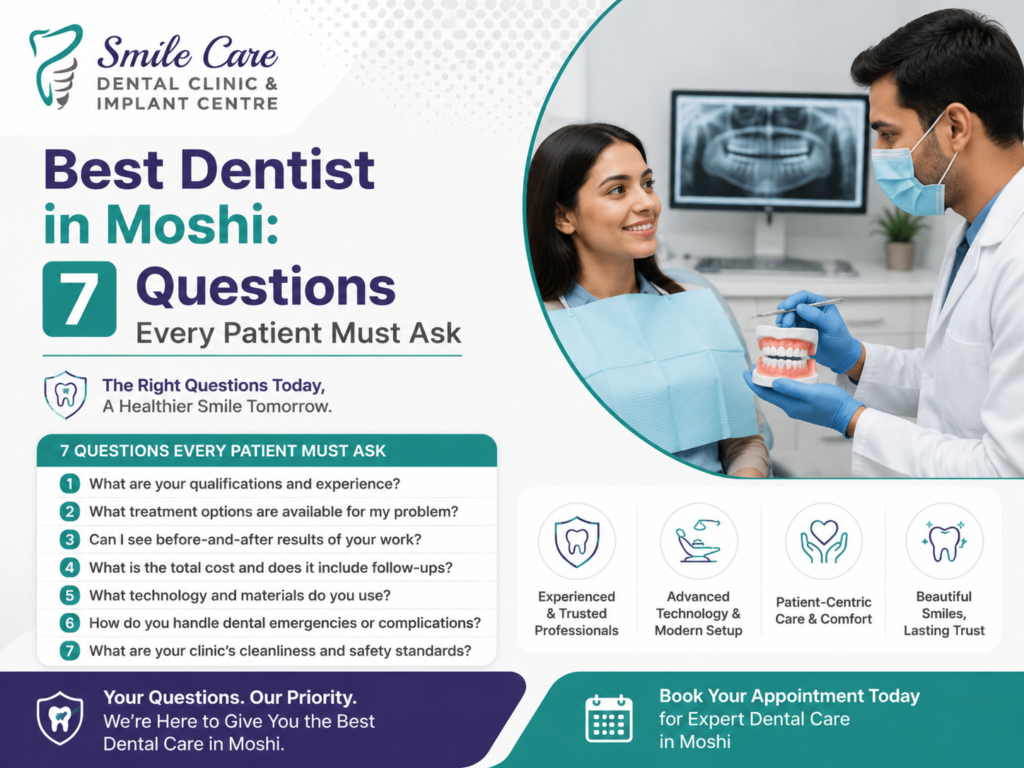
Finding the best dentist in Moshi, Pune, is not simply about proximity — it is about qualifications, equipment, sterilisation protocols, and honest communication. Moshi is home to a growing residential population across sectors adjacent to PCMC including Chikhali, Bhosari, Kasarsai, Dehu Road, and Ravet. With that growth has come an increase in dental clinics of varying quality. This guide gives you seven specific questions to evaluate any dental clinic before entrusting your oral health to them.
Smile Care Dental Clinic and Implant Centre, Moshi, is led by Dr. Pawan B. Sawalakhe, MDS Periodontist and Implantologist, and Dr. Vishakha Sawalakhe, MDS Prosthodontist and Implantologist — one of the few dual-MDS clinics in the PCMC region.
Question 1: What Are the Doctor’s Qualifications?
The minimum dental degree in India is BDS (Bachelor of Dental Surgery), a five-year programme. An MDS (Master of Dental Surgery) requires three additional years of postgraduate study in a specific speciality such as Periodontology, Prosthodontics, Orthodontics, or Oral Surgery.
For complex procedures such as dental implants, root canal treatment, smile designing, or orthodontics, an MDS-qualified specialist has significantly more focused training than a general BDS dentist. Ask to see the degree certificate or verify the registration number on the Dental Council of India website.
| Degree | Duration | What They Can Do |
| BDS | 5 years | General dentistry, basic fillings, extractions, simple RCT |
| MDS – Periodontist | BDS + 3 years | Advanced gum treatment, dental implants, bone grafting |
| MDS – Prosthodontist | BDS + 3 years | Crowns, bridges, dentures, smile designing, full mouth rehab |
| MDS – Orthodontist | BDS + 3 years | Braces, aligners, bite correction, jaw alignment |
| MDS – Oral Surgeon | BDS + 3 years | Surgical extractions, jaw surgery, complex implants |
Question 2: Is the Clinic Registered and the Doctor DCI-Verified?
Every practising dentist in India must be registered with the Dental Council of India (DCI) or the relevant State Dental Council. Registration details are publicly searchable. A legitimate clinic will have the registration certificate displayed at the reception. If a clinic hesitates to provide its registration number, treat that as a red flag.
Question 3: What Sterilisation Protocol Does the Clinic Follow?
Dental instruments that enter the mouth must be sterilised using an autoclave — a high-pressure steam sterilisation device. Single-use items such as needles and gloves must be disposed of after each patient. The WHO has identified inadequate sterilisation as a key contributor to preventable dental infection incidents.
- Ask: Does the clinic have an autoclave on the premises?
- Ask: Are instruments sterilised between each patient?
- Ask: Are single-use disposables used for needles, cups, and saliva ejectors?
- Ask: Is the dental chair cleaned with a disinfectant between patients?
Question 4: What Diagnostic Equipment Is Available?
A well-equipped dental clinic should have at minimum: digital X-ray (OPG/periapical), and ideally CBCT scanning for implant cases. Digital X-rays use up to 70% less radiation than conventional film X-rays and provide instant, high-resolution images.
For implant planning, a CBCT (Cone Beam Computed Tomography) scan is essential to assess bone density, canal proximity, and sinus anatomy. Clinics without CBCT capability for implant cases are relying on 2D X-rays, which provide insufficient information for safe surgical planning.
Question 5: Does the Clinic Offer Transparent Written Cost Estimates?
A trustworthy dental clinic will provide a written treatment plan with itemised costs before any procedure begins. This should include: the procedure name, the material being used, the number of visits, and whether any additional costs (such as X-rays, bone grafts, or lab fees) are included or separate.
Avoid clinics that quote verbally without documentation or that present additional charges only after the procedure has begun. At Smile Care Dental Clinic, Moshi, written treatment plans are provided at the consultation visit.
Question 6: What Specialities Does the Clinic Handle In-House?
A general dental clinic refers out to specialists for complex procedures. A multi-specialist clinic handles implants, orthodontics, prosthodontics, and endodontics under one roof. This reduces the burden on the patient of managing multiple clinics and records, and enables better coordinated treatment planning.
Smile Care Dental Clinic, Moshi, handles the following in-house with MDS specialists: dental implants, bone grafting, smile designing, crowns and bridges, full mouth rehabilitation, gum treatment, root canal treatment, and teeth whitening. Orthodontic cases including braces and aligners are also managed at the clinic.
Question 7: How Does the Clinic Handle Emergencies and Follow-Up?
Dental emergencies — a broken crown after implant placement, post-operative pain, a dislodged temporary restoration — can happen outside clinic hours. Ask whether the clinic provides a direct contact number for emergencies and how quickly a same-day appointment can be arranged for genuine urgent cases.
Good clinics also send appointment reminders, provide post-procedure care instructions in writing, and schedule follow-up visits automatically rather than leaving the patient to remember.
Choosing a Dentist in Moshi: Local Context
Moshi residents in Sector 1 through to the PCMC boundary near Chikhali and Bhosari now have access to specialist dental care without travelling to central Pune. The distance to established dental districts in Aundh or Shivajinagar is 20 to 30 minutes in normal traffic and longer during peak hours. For families with children, working professionals, and elderly patients, a specialist clinic within Moshi itself is a significant convenience advantage.
Smile Care Dental Clinic and Implant Centre at Moshi offers specialist services with two MDS-qualified doctors. The dual-MDS setup means implant cases benefit from periodontal expertise for tissue management alongside prosthodontic expertise for the final crown and prosthetic design.
Frequently Asked Questions
A: For general dentistry, a BDS degree is the minimum qualification. For specialist procedures like dental implants, root canals, orthodontics, or smile designing, look for a dentist with an MDS (Master of Dental Surgery) in the relevant speciality. At Smile Care Dental Clinic, Moshi, both lead doctors hold MDS degrees from Government Dental College, Aurangabad.
A: You can verify a dentist’s registration on the Dental Council of India website (dciindia.gov.in) or the Maharashtra State Dental Council portal. Enter the registration number provided by the clinic. A registered dentist’s name, degree, and registration status are publicly listed.
A: Ask about the doctor’s qualification for that specific procedure, the sterilisation protocol used, whether a written cost estimate is provided, what the procedure involves step by step, how many visits are required, and what to do in case of a post-procedure complication.
A: Yes, Smile Care Dental Clinic, Moshi, handles paediatric dentistry including children’s first dental visits, fluoride treatment, fissure sealants, and early orthodontic screening. The clinic environment is designed to be welcoming for patients of all ages.
A: Moshi serves as a convenient specialist dental destination for residents of Chikhali, Bhosari, Kasarsai, Dehu Road, Ravet, and Hinjewadi. Smile Care Dental Clinic at Moshi provides MDS-level care that previously required patients to travel to central Pune or Mumbai.
Conclusion
The best dentist in Moshi is one who combines verified qualifications, transparent communication, proper sterilisation, modern diagnostic equipment, and specialist in-house capability. These seven questions give you a practical checklist to evaluate any clinic before committing to treatment.
Smile Care Dental Clinic and Implant Centre, Moshi, welcomes new patients for a consultation with Dr. Pawan B. Sawalakhe or Dr. Vishakha Sawalakhe. Visit smilecaredentalpune.com to book your appointment.
Dr. Pawan Sawalakhe
Dr. Pawan B. Sawalakhe is a highly experienced Periodontist and Implantologist known for his expertise in advanced gum treatments and dental implant procedures. He completed his M.D.S. from Government Dental College & Hospital, Aurangabad and has served as an Assistant Professor there. With a patient-friendly and gentle treatment approach, he provides long-lasting, painless solutions for gum diseases and dental implant cases.